


 Tiếng Việt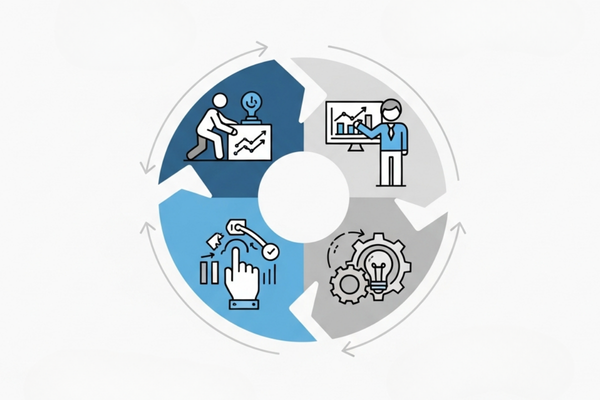
A company’s core competitive advantage no longer lies in the number of qualifications its employees hold, but in how quickly they learn and how effectively they turn experience into action. Experiential Learning has emerged as a transformative methodology that breaks away from the limitations of traditional education—where learners are treated merely as passive “containers” of knowledge.
This article explores the structure of Kolb’s Learning Cycle, explains why real-world experience is the greatest teacher, and examines how leading organizations apply this philosophy to build high-performing teams.
1. The Essence of Experiential Learning: More Than Just “Learning by Doing”
Many people mistakenly believe that Experiential Learning simply means throwing employees straight into the job. In reality, action alone is not enough. Without deliberate reflection and learning, “doing” becomes nothing more than the mechanical repetition of the same tasks.
According to David Kolb, the founder of this theory, knowledge results from combining the process of grasping an experience with transforming that experience. Experiential Learning is a continuous process in which understanding is constructed through interaction between the learner and the real-world environment.
In this approach, mistakes are not viewed as failures or something to be ashamed of. On the contrary, within the Experiential Learning framework, mistakes are the most valuable raw material for growth. Without real-world setbacks and missteps, the brain lacks the stimulus needed to trigger reflection, challenge existing assumptions, and generate creative solutions.
2. Decoding the Four Stages of Kolb’s Learning Cycle
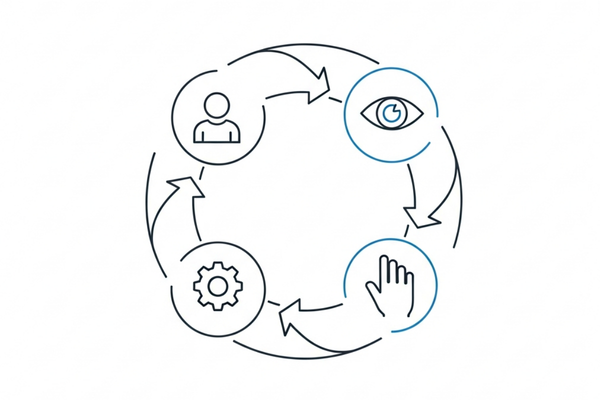
For a real-life experience to become genuine knowledge, learners must complete the entire four-stage learning cycle, with each stage reinforcing the next. If any stage is skipped, the Experiential Learning process is interrupted, limiting both understanding and long-term growth.
Stage 1: Concrete Experience
This is the starting point of all learning. Learners engage directly in a real-world situation. In a business environment, this may involve operating a new production line, handling a customer complaint, or implementing a Lean improvement project.
-
Key characteristic: Focuses on direct experience, firsthand observation, and real-world interaction.
-
Role: Provides the raw input from real-world experience. Without this foundation, every theory built afterward is nothing more than building castles on sand.
Stage 2: Reflective Observation
After the experience, learners need to step back and reflect on both the situation and their own actions. This is the stage where they ask questions such as, “What happened?”, “Why did the plan fail?”, and “How did I feel at that moment?”
-
Key characteristic: Requires honesty with oneself and the ability to analyze experiences objectively.
-
Role: This stage helps learners uncover the blind spots they failed to notice while they were actively engaged in the task. It serves as a critical bridge, transforming an experience into a meaningful lesson in the Experiential Learning process.
Stage 3: Abstract Conceptualization
Based on the reflections from the previous stage, learners begin to make logical sense of the experience. They connect seemingly isolated events to develop new principles, concepts, or mental models. For example: “I realized that without proper preparation during the 5S stage, the assembly process will consistently be delayed by 10 minutes.”
-
Key characteristic: Involves logical thinking, abstraction, and hypothesis building.
-
Role: Transforms personal experience into systematic knowledge that can be shared and applied more broadly.
Stage 4: Active Experimentation
This is the validation stage. Learners apply the mental model they have just developed to a new real-world situation.
-
Key characteristic: Involves taking action, testing hypotheses, and improving processes.
-
Role: Completes the learning cycle. If the experiment succeeds, the knowledge is reinforced. If it fails, the outcome becomes a new Concrete Experience, initiating the next learning cycle. This embodies the spirit of Kaizen within Experiential Learning.
3. Why Is Real-World Experience the Best Teacher?
In traditional education, we are often taught theory before putting it into practice. This can create a psychological barrier: learners may feel that what they are learning has little relevance to their real lives. Experiential Learning reverses this process for the following reasons:
Strong Neural Engagement
When we engage directly in an experience—especially when facing difficulties or making mistakes—the brain releases neurotransmitters that can strengthen memory formation. The anxiety of dealing with a machine breakdown or the excitement of discovering a solution can make the lesson far more memorable than passively listening to a lecture.
Adaptability in Complex Environments
The real world does not operate according to the neat, predictable examples found in textbooks. Experiential Learning develops the ability to adapt and respond effectively when information is incomplete, time is limited, and unexpected variables arise. This is why Lean experts consistently emphasize that leaders must go to the Gemba—the actual place where work happens and where the truth can be observed firsthand.
Building Confidence and Proactiveness
When employees work through Kolb’s Learning Cycle to solve a problem on their own, they realize that they have the ability to change and improve the status quo. This builds professional confidence and a strong sense of ownership—qualities that no purely theoretical training program can fully develop.
4. Applying Experiential Learning in Corporate Training and Lean
In Lean-driven organizations such as Athena I&E, Experiential Learning is not merely a training methodology—it is an integral part of the operational strategy.
The 70-20-10 Learning Model
Leading organizations embrace the 70-20-10 model: 70% of learning comes from real-world experience, 20% from interactions with others through coaching and mentoring, and only 10% from formal training. This aligns closely with Kolb’s philosophy. Organizations therefore need to create an environment where employees are empowered to experiment, learn, and reflect as part of their everyday work.
On-the-Job Training (OJT)
Instead of bringing workers into a meeting room to teach them about 5S, take them to the shop floor. Let them arrange the tools themselves, observe the inconveniences, reflect on the time being wasted, and then work together to establish a new standard. This is Experiential Learning in its most practical form.
Blame-Free Culture
For Kolb’s Learning Cycle to function effectively, organizations must accept mistakes as part of the learning process. If employees fear being punished for making mistakes, they are likely to hide those experiences. When experiences are concealed, reflection cannot take place, and valuable lessons are lost. Successful Lean organizations treat every mistake as an opportunity for the entire system to learn and improve.
5. Challenges in Implementing Experiential Learning
Although highly effective, implementing this approach is not always easy. Common barriers include:
-
Impatience: Leaders often expect employees to get things right from the start in order to save time, inadvertently depriving them of valuable opportunities to learn from their mistakes.
-
Lack of Reflection Skills: Many people work extremely hard but never stop to engage in Reflective Observation. As a result, they may repeat the same mistake for years while still calling it “experience.”
-
Outdated Performance Evaluation Systems: When KPIs focus solely on short-term results, employees are more likely to play it safe rather than experiment with new and innovative approaches.
6. A Five-Step Roadmap for Building an Experiential Learning Organization
-
Design a Safe Learning Environment: Allow employees to experiment, make mistakes, and learn within small-scale projects or designated Model Areas.
-
Develop Reflection Skills: Teach employees how to ask “Why?” using the 5 Whys technique to identify root causes after each experience.
-
Digitize Knowledge: Use tools such as AppSheet or internal knowledge management systems to document Lessons Learned captured during Stage 3 of Kolb’s Learning Cycle.
-
The Role of the Coach: Managers do not solve problems on behalf of employees. Instead, they act as facilitators, guiding employees through the entire Kolb Learning Cycle on their own.
-
Celebrate Improvement: Reward teams not only for results, but also for their efforts to experiment, learn, and continuously improve.
Conclusion: A Never-Ending Journey
Experiential Learning is a marathon, not a sprint. Kolb’s Learning Cycle never truly ends; it is an upward spiral in which each new experience builds upon the lessons learned from previous ones.
For Vietnamese businesses embarking on a Lean transformation journey, understanding and applying Experiential Learning is key to unlocking the full potential of their people. Remember: an organization that knows how to learn from its mistakes is an organization that never truly fails. Real-world experience may be a demanding teacher, but its rewards are profound growth and a competitive advantage that cannot be easily replicated.
Start empowering your team to experience, reflect, and innovate today. The future of your organization lies in the lessons drawn from the very “scars” of real-world practice.
